Bath textiles · Fiber and care
Why Cotton Bath Towels Work: Absorbency, Comfort, and Care
A cotton towel’s everyday usefulness begins at the scale of a fiber. Its structure helps take up water, while yarn, weave, pile, and weight shape how the finished cloth feels and dries. Knowing how those elements work makes it easier to choose a towel—and care for it—with realistic expectations.
After a shower, a towel has a simple assignment: collect moisture from skin, feel comfortable in the process, and be ready for another turn after laundering. Cotton has earned a lasting place in bath linens because it can do all three reasonably well. The fiber is absorbent, familiar against the skin, and adaptable to many kinds of textile construction, from light flat weaves to thick, looped terry.
Yet “cotton” alone does not tell the whole story. Two cotton bath towels can behave quite differently. One may feel airy and dry quickly; another may have a deep, cushioned pile that takes longer to dry. Fiber length, yarn preparation, loop design, fabric density, finishing, and routine care all influence the result. Understanding the difference between the fiber and the construction helps explain why—and how to look beyond a single label when assessing towel performance.
The fiber’s first advantage: taking up moisture
Cotton is a plant-based cellulose fiber. Its natural structure interacts readily with water, allowing moisture to move into and along the fiber rather than simply remaining as droplets on the surface. In a towel, that capacity helps transfer water away from the body as the cloth is pressed or drawn across damp skin.
Absorbency is not a single switch that is either on or off. It is affected by the fiber’s condition and by the spaces created when fibers are spun into yarn and woven or knitted into fabric. A towel must offer both material that can take up water and a usable surface that can make contact with it. Terry loops provide a great deal of that surface area: their raised shape presents many points of contact and creates small spaces in which moisture can spread.
That is why cotton terry is such a familiar bath-towel construction. The loops are not merely decoration. They contribute to the towel’s capacity to pick up water, and their height and density help determine whether the fabric feels springy, compact, lofty, or relatively light. Still, a deeper pile does not automatically mean a towel is better for every household. More fabric can increase the towel’s weight and may lengthen drying time, especially in a humid bathroom with limited airflow.
A new towel may also behave differently from one that has been washed several times. Factory finishing, handling, or residual materials can temporarily affect how readily water spreads across a textile. With regular laundering, some towels become more receptive to water. Use, detergent, and drying conditions matter, so the pace and degree of change vary. A useful test is practical rather than dramatic: does the towel take up moisture comfortably during normal use, and does it dry adequately between uses?
Fiber length, yarn, and the feel of cotton
Cotton fibers vary in length. Longer fibers can be spun into smoother, more continuous yarns, with fewer fiber ends protruding from the thread. In towel fabrics, yarn quality can contribute to a surface that feels smoother and may be less prone to shedding than a yarn made with shorter fibers. This is one reason product descriptions often distinguish long-staple cotton from cotton described more generally.
Fiber length is useful information, but it is not a complete measure of performance. Spinning, twist, finishing, pile design, and the overall quality of construction remain important. A well-made towel depends on the way its parts work together. Long fibers cannot compensate for weak seams or unsuitable care, just as a dense pile does not by itself guarantee ideal absorbency or easy drying.
The twist of the yarn is another consideration. Twist helps hold fibers together, but different yarn constructions can produce different levels of softness, strength, and openness. Some towels are designed with a more open, airy cotton structure, while others use a compact, tightly constructed yarn. A low-twist or zero-twist approach may create a particularly soft, plush feel, though the product’s overall durability and care directions still matter. The label gives a starting point; ordinary use tells you how the towel works in your home.
Softness, meanwhile, is partly a matter of touch and partly a result of construction. A towel can feel plush because of its raised loops, the yarn, or finishing applied during manufacture. Softness does not necessarily mean greater absorbency. Some fabric treatments can leave a coating on fibers that changes how water spreads across the surface. If a towel seems to repel water, a thorough wash and careful use of detergent may help; repeated use of fabric softener can sometimes contribute to reduced water uptake.
Terry loops, flat weaves, and the role of construction
Many bath towels are terry: their loops stand above the base fabric. This construction offers a cushioned hand and substantial surface area, and it is often associated with the familiar soft, absorbent towel used after bathing. Loop height and density help define the experience. Taller or more numerous loops can make a towel feel fuller, while a more restrained pile can produce a less bulky fabric.
Flat-woven cotton towels take a different approach. Without the same raised pile, they are generally lighter and fold into less space. A flat weave can still absorb water, while its lower bulk may allow the cloth to dry relatively quickly. The precise result depends on the yarn and weave, as well as the room’s temperature, humidity, and ventilation. Flat-weave towels are not simply “less absorbent” terry towels; they are a different construction, with a different balance of texture, weight, and drying behavior.
Channel weaves and other textured structures can also change how a cotton towel feels and performs. Narrow channels, ribs, or variations in weave introduce a surface pattern and can create a lighter hand than dense terry. In the same way, the edges, hems, and stitching matter beyond appearance. Secure finishing helps the towel withstand repeated handling and laundering, while weak or strained edges may fray or distort over time.
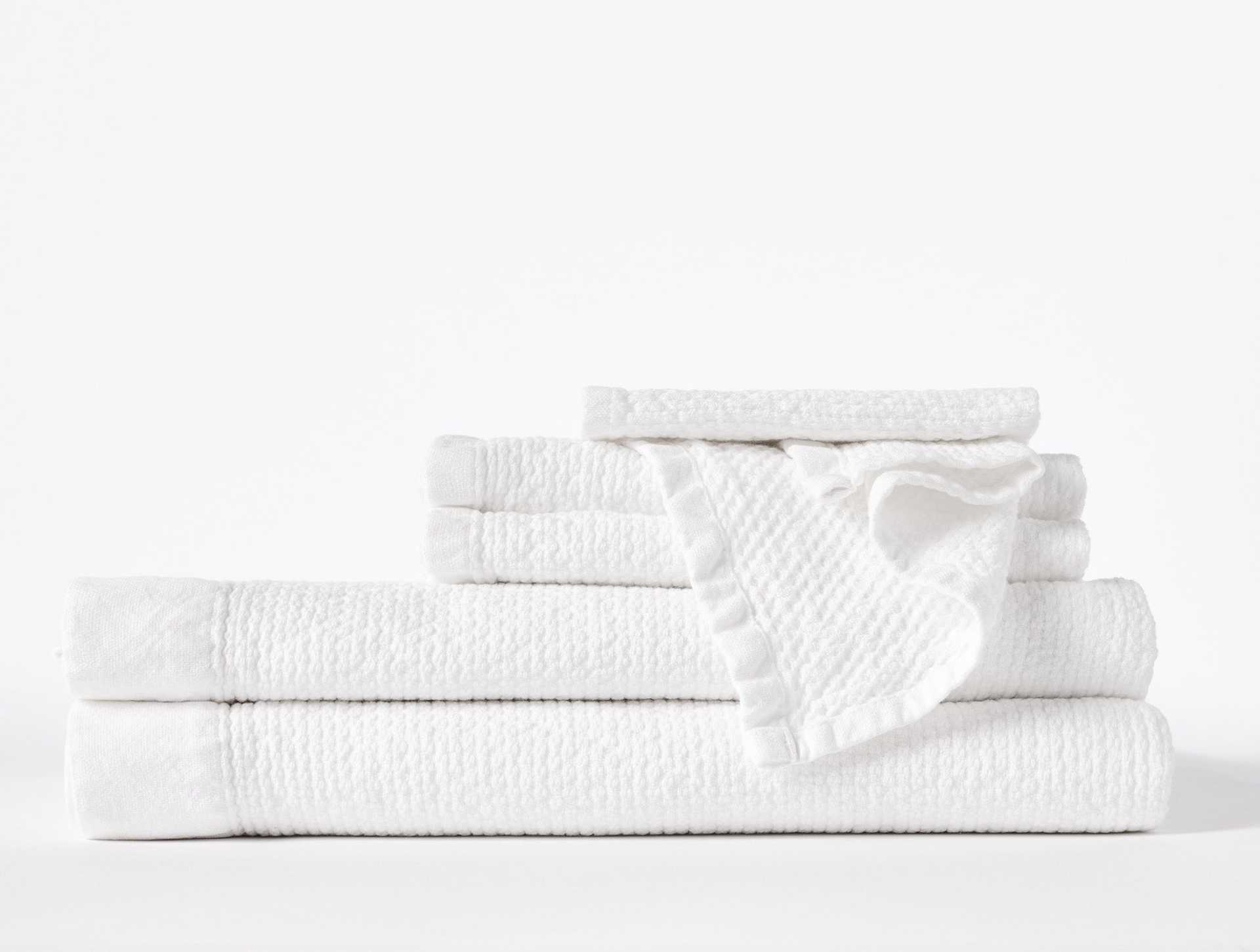
Consider the Adriatic Organic Towels as one example of how these construction choices are described: they are made from organic cotton with a lightweight, textural weave and garment-dyed finish, and are characterized as naturally absorbent and quick-drying. That description points to a particular combination of fiber, surface, and weight—not a universal promise that all cotton towels behave alike. Read the Adriatic Organic Towels specifications to see how the material and care details are presented together.
What GSM tells you—and what it does not
GSM means grams per square metre. It describes a fabric’s weight per unit of area and is often included in towel specifications. As a general guide, a lower GSM towel tends to feel lighter and less bulky, while a higher GSM towel often feels denser or more substantial. Those tendencies can help readers compare towels, but GSM is not a direct measure of quality, absorbency, softness, or drying speed.
Construction complicates any simple comparison. Two towels with similar GSM may feel different if one has a looped terry pile and the other a flatter, more open weave. Their fiber and yarn can differ, too. A high-GSM towel may feel wonderfully enveloping but require more room and time to dry. A lighter towel can be easier to launder and store, yet may not provide the same cushioned sensation.
Think of GSM as one clue rather than a verdict. Ask what the towel is for, how often it will be used, and where it will hang between uses. In a bathroom that stays humid, quick drying and adequate ventilation may be more important than maximum thickness. For someone who values a weighty, plush feel and has room to dry linens thoroughly, a denser towel may suit the routine. The most useful choice is the one whose characteristics fit the setting.
How washing affects softness and absorbency
Laundry is part of a towel’s working life. A wash removes body oils, soil, and residues that accumulate with use, but detergent or softener left in the fabric can affect how the towel handles water. Too much detergent may not rinse away fully, particularly in an overloaded machine or a wash cycle with insufficient water. Over time, residue can make fabric feel stiff or leave it less responsive to moisture.
Fabric softener is designed to make laundry feel smoother, but many softeners work by depositing conditioning agents on fibers. That coating can reduce water uptake in some towels. If absorbency is the priority, try washing without softener and see whether performance improves. Dryer sheets can have a similar coating effect. Neither every product nor every towel will respond identically, so it is sensible to follow the manufacturer’s directions and make changes one at a time.
For many cotton towels, a straightforward routine is best: wash with like colors, use a suitable amount of detergent, avoid crowding the washer, and select the care-label temperature and cycle. New towels can be washed before first use. This removes handling residues and allows the fabric to enter its regular laundering routine. There is no need to rely on harsh chemicals or elaborate home remedies as a universal treatment.
Water hardness can also influence how laundry feels. Mineral-rich water may make soap and detergent less effective at rinsing clean, potentially leaving buildup on fabric. If towels become unusually rough or seem to lose absorbency despite careful washing, consider whether detergent dosing, machine loading, rinse performance, or local water conditions may be involved. A periodic wash following the towel’s care instructions can help refresh the fabric, but avoid combining cleaning agents or using them contrary to their labels.
Drying: protecting the loop and allowing air to move
After washing, a towel needs room to release moisture. Shake it out before drying to separate the fabric and loosen flattened loops. In a dryer, choose the temperature allowed by the care label; moderate heat is often a practical choice for cotton towels. Excessive heat and repeated over-drying can place unnecessary stress on fibers and seams, while a towel that remains damp for too long may develop an unpleasant smell.
Air-drying can reduce dryer use, but it works best when the towel is spread out rather than folded over itself in a thick bundle. Leave space between hanging towels so air can circulate. In a small or humid bathroom, a towel rail near good ventilation may dry fabric more effectively than a crowded hook. The goal is not merely to make the towel feel dry on the surface, but to let the thicker sections and hems dry fully.
Do not iron terry pile unless the care instructions specifically call for it. Ironing can flatten the loops that help give the towel its texture and surface area. If a particular cotton towel includes an ironing recommendation, follow its label; many everyday towels need no ironing at all.
A practical cotton bath towel care routine
Consistent, moderate care usually serves cotton towels better than aggressive cleaning. A basic routine keeps the fabric usable while limiting avoidable wear:
- Wash new towels before use, following the label and separating colors as appropriate.
- Use detergent according to the load size and product instructions; more is not necessarily cleaner.
- Avoid overloading the washer so water and detergent can move through the fabric and rinse away.
- Use fabric softener sparingly or omit it if water absorption is a concern.
- Tumble-dry on the permitted setting or hang towels with enough space for airflow.
- Let each towel dry fully between uses, especially in a warm or humid bathroom.
- Check care labels before using bleach, stain treatments, or unusually high temperatures.
For organic cotton towels, the same everyday principles apply, but the care label remains the most reliable guide for the finished product. Certification statements describe particular standards or supply-chain requirements; they do not remove the need to launder the textile appropriately. Care and material information belong together when assessing what a towel offers.
Choosing a towel for the way you live
Begin with the bathroom rather than an abstract ranking of towel features. If towels are shared by several people or washed frequently, durability, easy laundering, and enough space for drying may be central. If storage is tight or a towel travels between home and a pool, a lighter construction can be more convenient. If the preferred experience is a warm, substantial wrap after bathing, a heavier terry towel may be worth the extra drying time.
Also consider size. A hand towel, guest towel, bath towel, and bath sheet serve different needs. A larger piece offers more coverage, but takes up more room in the washer and dryer and can take longer to dry. The right dimensions depend on the person using it and the available storage—not simply on the largest size listed.
Look for clear product information: fiber content, construction, weight if supplied, country of origin where available, and care instructions. Descriptions such as “plush,” “quick-drying,” or “soft” are helpful only when considered alongside those details. For example, cotton and lyocell blends are not the same as 100% cotton; a flat weave is not terry; and a garment-dyed finish is a manufacturing detail rather than a measure of absorbency by itself.
Finally, judge performance over time. A towel that meets a household’s routine, remains comfortable after regular washing, and dries reliably may be a better fit than one chosen solely for maximum weight or initial softness. Cotton’s versatility is precisely that it can be made into many useful forms. The task is matching the form to the everyday setting.
Common questions about cotton towel absorbency
Are thicker cotton towels always more absorbent?
No. Thickness and GSM can indicate a heavier or fuller fabric, but they do not independently measure how effectively a towel absorbs water. Fiber, yarn, pile, finishing, and laundering all contribute. A thick towel may hold more moisture within its structure, but it may also take longer to dry.
Why does a new towel sometimes seem less absorbent?
Finishing residues or coatings may influence how water spreads across a new towel. Wash it according to the care label before use and avoid adding fabric softener if water uptake is a concern. If the issue continues, review the detergent amount and rinse routine.
Does cotton dry quickly?
It depends on the towel. A lighter or more open construction may dry sooner than a dense, high-pile towel, but airflow, room humidity, temperature, and how the towel is hung also matter. Fiber content alone cannot predict drying time.
How can I keep cotton towels soft without reducing absorbency?
Use an appropriate amount of detergent, avoid overloading the washer, rinse thoroughly, and dry with enough airflow. If you use fabric softener, consider reducing or omitting it to see whether absorbency improves. Follow the care instructions for the particular towel rather than assuming every cotton construction responds the same way.
The everyday science in a familiar textile
A cotton bath towel is a small piece of textile engineering at work in an ordinary room. The fiber contributes an affinity for moisture; yarn and weave turn that fiber into a usable cloth; loops, weight, and finishing shape how the towel feels in the hand. Washing and drying then become part of the design’s ongoing life.
Understanding those layers makes the language of towels more useful. “Cotton” identifies the main fiber, but not the whole experience. A towel’s absorbency, comfort, and drying behavior emerge from the relationship between material, construction, and care. Choose with those factors in mind, and a familiar bathroom essential becomes easier to evaluate—and easier to keep working well.